

How to Create Triathlon Training Plans
How to Create Triathlon Training Plans: A Guide for Triathlon Coaches
If you’re a swimming coach looking to help your clients train for a triathlon, read on for our guide on how to create triathlon training plans.
Training for a triathlon takes a lot of commitment and hard work. Many of those who take part are regular runners and cyclists but find the swimming leg particularly tough. Regular training for a triathlon will help athletes see improvement over time but the quickest and surest way to find success is to seek a triathlon coach or a swimming coach.
- Gauge the level your student is at
- Ensure they know how to regulate their breathing
- Explain how to acclimatise and the risks that come with cold water
- Develop a risk assessment for the event
- Practice Pack Swimming
- Mentally prepare for the Cycle Stage with Efficient Swimming

Gauge your triathlete’s level of open water swimming
Understanding the ’accurate’ swimming level of your client is important because it will dictate the kind of training plan you will prepare for them in the run-up to the event and the specific areas they should focus on to improve their swimming.
If they’re a complete beginner to the water but are already competent runners and cyclists, then you should discuss how they might want to divide their time to ensure their swimming gets enough attention. While they shouldn’t stop running and cycling training altogether if they’re new to outdoor swimming, it stands to reason that they should spend more time training for this leg. If they don’t complete the swim, all of their hard work training for the cycle leg will amount to nothing as they’ll be out of the race.
Explain to your client that it will benefit them, in the long run, to go into the swim feeling efficient and confident, so their running and cycling training should not leave them feeling too fatigued to train properly for the swim.
Depending on the distance of your client’s triathlon, it would be advisable to encourage them to swim a minimum of twice a week. If they are completely new to open water then you might want to push that to three times a week in the few weeks before the race, particularly if the triathlon is Olympic distance or longer.
Regulate Breathing
As an open water coach, you’ll already understand the importance of breathing and how much it can both positively and negatively impact a swimmer’s performance. Ensure your swimmers spend time on this, not just from an efficient swimming technique but also from a stress-relieving perspective.
If nerves are at play on race day, or if the water is likely to be cold enough to induce cold water shock, then it’s a good idea to practise some pre-race calming strategies such as slowing the breath in order to calm the swimmer down, inhaling slowly through the nose for 3 counts and exhaling even more slowly through the mouth for 6 counts.
Triathlete’s who are inexperienced in the open water are more liable to experience cold water shock. This natural response to cold water immersion is felt within the first 30 seconds up to 2 minutes. You can read more about this in our ultimate guide to cold water swimming.
If a swimmer does experience cold water shock or panic, this can have consequences on their performance during the race. Ensuring they know how to handle nerves or cold water shock can only strengthen their position on race day.
Acclimatisation
Regular acclimatisation will help to reduce the effect of cold water shock and habituate the swimmer to cooler water temperatures. If your client is new to open water swimming it’s advisable to be consistent with their habituation to cooler water. They should aim to do three or four short dips in a week rather than two long swims. Although triathlons are unlikely to be held in cold water, the open water is always going to be cooler than water in swimming pools so it is important that your clients are comfortable in the expected water temperature of their race.
Our ultimate aim as coaches is to help to empower our swimmers so here is a list of questions you can ask your client to consider. This will help them think about how they can be as best prepared and as acclimatised as possible on the day.
- Will you be wearing a wetsuit and have you swum in one before?
- What time of year will it be and have you run or cycled at that time of year previously?
- How much do you know about the venue?
- What is the swim course like, is it salt or fresh water?
- Where are the start and the finish of the race?
- What will you have eaten that day and have you trained using a nutrition plan?
- Even the sprint triathlons are a long time to spend exercising, so have you considered a hydration strategy?
Know the Race
It might seem like a big ask, but if you know the race then you’ll be far better equipped to help your client to swim it. We’re not suggesting that you enter too (though you might like to!) but work together with your swimmer to find out as much information as possible about the event. Things you might research:
- Where are the feeding stations?
- What will the facilities be?
- Which direction is the course, clockwise or anti-clockwise?
- Where is the swimming leg held?
- How many buoy turns are there?
- How many people are starting in each wave?
- What is the average temperature and conditions of the water at that time of year?
- What does transition 1 look like? How might you find your bike?
- What level is this triathlon, are there beginners entering or is it highly competitive?
Help your swimmer create a risk assessment
As a coach, you will understand the importance of creating a risk assessment both before you coach your own clients and before swimming in an event. If you and your swimmer have done research on the event then you should have a good idea about some or all of the risks involved. Take a look at our short course on ‘How to Conduct a Risk Assessment’ if you need a refresher. Some questions you might want to ask your client are:
- What are the entry and exit points into the water?
- What should you do if there’s a problem?
- What equipment will you need?
- Where will you find the equipment you need to swim/ where is it stored and how many other people will be in that space at the same time as you?
- What will the weather be that day?
- If the weather is poor, what needs to change in how you conduct yourself on the day?
- What are some potential hazards in and around the venue?
Practising Pack Swimming
Something that is unique to most swimming events and that someone who is training for a triathlon may not have considered is how many other people will be in the water with them. For someone who has never swum in an event before, this is likely to feel overwhelming, so it’s important to coach your client to remain calm. Some things you may wish to work on with your swimmer are:
- Where in the swim start do they feel most comfortable swimming?
- Now imagine being surrounded by other swimmers. Does that change?
- Where do they feel least comfortable?
- If you have the opportunity, practise swimming in their least comfortable area in a safe environment so they’re mentally prepared and are ok with being uncomfortable
- Practise swimming in a busy environment
Coach How To Transition To The Cycle Leg Effectively
Coaching your swimmer to their peak swimming performance doesn’t stop when they leave the water. A crucial part of hitting their personal best is how they get out and navigate their way to their bike safely.
Practising how to exit the water is a great confidence boost to the swimmer as they’ll know exactly what to expect. 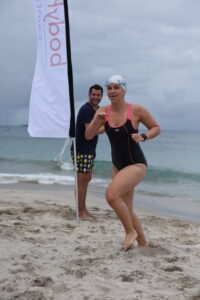
In training sessions practise how the swimmer might feel going from vertical to horizontal in a quick movement. You might find that some swimmers experience “jelly legs”. Ideally, the swimmer should look to avoid the blood pooling in their core or internal organs. If there is already blood flow to the legs then they are less likely to experience fainting or feeling faint.
The best way to help them overcome this is to increase the blood flow in the legs before they exit the water. To do this, with 100m to go before the exit get your swimmer to kick their legs really hard for 10 seconds, then repeat this gain when they are about 20m out.
Once they have mastered this technique, you should practise how they run out, find their bike and get out of their wetsuit if they are using one and change into their cycling shoes or tri suit. Arming your swimmer with all the things that might stand in their way will mentally prepare them and should help with a speedier, calmer transition.
Prepare for the Cycle Stage with Efficient Swimming
Many people who enter a triathlon are strong runners or cyclists but they struggle through the swimming leg. It’s usual that when they leave the water, they may feel frazzled or under additional pressure. Leaving the water in this way might put someone in the wrong frame of mind to compete in the next leg. They might already feel defeated, not ideal for beginning the cycle leg.
Coach the swimmer to swim efficiently. Reassure your swimmer that by putting in the time and effort to learn how to swim efficiently, they are far more likely to go into the cycle leg feeling calm and collected. If they can preserve energy in the swim, it will help them in the long run. Use the Straight Line Swimming methodology to cover the fundamentals of breathing, body position, rotation and propulsion before working on the specifics of their stroke.
Straight Line Swimming has three CPD courses on breathing, body position and motion. At just one hour each and all online, they’re a great refresher for any coach to take before they train a swimmer for a triathlon. Remember, while these three things are fundamental to your swimmer’s success, making sure they’re safe and comfortable in the water should be your priority.
View our CPD courses on breath, motion and position in the water.