Menopause and exercise should go hand in hand. Here’s our advice to open water swimming coaches on how to work with peri-menopausal and menopausal swimmers.
Table of contents
- What is menopause and how does it apply to outdoor swimming?
- Starting the conversation around menopause
- Mental health, menopause and how cold water swimming can help
- The benefits of movement for perimenopause
- The importance of sleep and diet
- Community in swimming and menopause
- Introducing menopause-specific classes to your coaching practice
You may have already heard of the benefits of open water swimming for menopausal and perimenopausal women. In this article we’ll discuss how open water swimming can benefit all women going through this stage in life and provide tips on how you as a coach can help make the experience a positive one.
As an open water swimming coach, you may have found a growing number of women over 40 in your own swimming groups.
A 2020 survey conducted by Outdoor Swimmer found that 65% of outdoor swimmers were female, compared to half in 2018. In the same survey, only 13% of the survey sample were below 40, while 20% are above 60.
In our latest ‘Evening With’ we spoke to the founder of the Menopause Movement and women’s health physio Christien Bird.
‘I realised how unprepared I was. And then I realised, if I’m a women’s health physio and I’m unprepared for the menopause, it’s quite likely that most people are relatively unprepared for this next phase in life.”
 ‘Every woman will have such a different experience. Some will sail through it, but most women don’t!’ she explained.
Whilst menopause is something that only happens to half the population, we encourage all coaches to learn more about it. Understanding more about menopause can unlock new skills as a coach and lead to new opportunities.
1. What is menopause and how does it apply to outdoor swimming?
Few people know that menopause itself is just a one-day event. The menopause happens 12 months after your last period.
Prior to this, a woman can experience symptoms that are often associated with menopause. But this is actually called perimenopause.
Menopause is the permanent end of a woman’s menstrual cycle and fertility. It typically occurs in someone’s 50s or 60s, but can happen earlier or later.
Menopause itself does not cause any health problems, but perimenopause can be a difficult time for lots of women. On average, it lasts six years, but it can be much shorter or much longer. For some women, it can last the rest of their lives.
Perimenopause is the transition period leading up to menopause when estrogen levels in a woman’s body fluctuate. This can cause irregular periods, hot flushes, tiredness, anxiety and other changes. The main thing to focus on here is that EVERYBODY is different and no person’s symptoms are the same. Check out this handy symptom checker on the My menopause centre website.
Some women are prescribed hormone replacement therapy for their specific perimenopause symptoms, but there are other steps that women can take to relieve the symptoms.
“A good diet, sleep and exercise are the three things we all need, in general, but especially during menopause,” advises Christien Bird.
 Passionate about the benefits of movement, Bird agrees that any form of swimming is a great way to exercise for those who are perimenopausal and some find that cold water swimming especially has really helped with symptoms like hot flushes.
“Women need to realise that women’s health matters,” she tells us. But she also stresses that each individual’s experience will be unique to them and as an open water coach we need to ensure we ask questions and focus on each individual swimmer’s needs, wants and goals.
2. Starting the conversation around menopause
Menopause has in the past been a bit of a taboo subject but the more we speak about it, the less taboo it becomes and the more we can help our swimmers. How can we go about starting one of these conversations with your swimmers?
Create a non-judgmental environment
Before starting a conversation about menopause or perimenopause, it’s vital for people to feel as though they are safe to talk about their experience. As experienced coaches, many of you may already be great at creating a safe space to talk in.
A non-judgemental environment might start with more active listening from yourself. Take the time to have a one-to-one conversation with each swimmer when they join your group. Ask them what their goals are and why they want to join you for swimming. Taking the time to understand each swimmer, this will help build rapport and trust.
Likewise, introduce ways to bring the swimming group together, if you are coaching in groups. This needn’t be anything as complex as games or group exercises if that’s not within your practice. It might be as simple as allowing people a chance to catch-up before and after the swim.
Say it like it is
Part of creating a non-judgemental environment is normalising bodily functions and feelings.
Bowel urgency is common in women going through perimenopause, so don’t be afraid to address this by pointing out the nearest facilities. The Menopause Movement Course is a great course to help you help your swimmers but giving you the techniques to help woman learn how to cope with bladder control so they can enjoy their open water experience.
You may also want to refer to your own experiences. People are far more likely to feel more comfortable discussing their own situation after you’ve opened yourself up to them, even if you are a male coach you may have experienced your partner, friends or mother go through this process.. We’re not suggesting you over share. Keep the topics related to the types of things that affect us all, rather than anything deeply personal.
Learn the symptoms
Educating yourself about perimenopause and menopause allows you to recognise the symptoms in your swimmers.
Arming yourself with this knowledge will help you to spot the signs and maybe help make small adjustments to your coaching plan to accommodate someone who is struggling through a symptom on that specific day.
For example, ask everyone how they are feeling at the start of the session. Is someone feeling more tired than usual? Then create adaptations they or anyone else are welcome to take if they’re not feeling fully energised,
Finally, if someone wants to talk about their symptoms with you, have the resources to hand that will help them. It’s best not to offer advice that’s hearsay or opinion, so ensure you refer to a reputable source like Positive Pause but ultimately, refer them to a medical professional like a women’s health physiotherapist or their GP.
3. Mental health, menopause and how cold water swimming can help
As a coach, it is likely that you will have already heard several theories around the positive effects of cold water swimming on mental health.
 In September 2018 the British Medical Journal published a report about the theories around cold water adaptation as a treatment for depression.
Whilst not all perimenopausal women will have depression, the 2019 research commissioned by Health & Her and carried out by Censuswide revealed that anxiety was more common in women during perimenopause.
Statistics by a Parliament committees also revealed that women aged 50 to 54 have the highest suicide rate in the UK.
It makes sense that menopause, mental health and cold water swimming often go hand-in-hand. Whilst no one knows exactly why cold water swimming is good for mental health, Prof Mike Tipton tells the BBC in this interview that, “There is a significant amount of anecdotal evidence that suggests that it works for some things, but we don’t know how.”
“Cold water swimming affects our pain receptors and temperature receptors inducing a cold shock response,” Neuroscientist Tara Swart explains.
This theory is well-reported but others also explain the correlation by being so close to nature along with the sense of community that’s so often found in open water swimming.
Drawing attention to some of the natural beauty nearby could be a great way to introduce a sense of mindfulness to your swimming group. If you teach in a lido, consider organising a group outing for those who are perimenopausal, and even those who are not, to a local wild swimming spot.
4. The benefits of movement for perimenopause
As we age, we naturally lose lean muscle mass and have an accelerated loss of bone mass. This means that we need to be even more careful about what we eat, drink and how much sleep we get. We’ll explore this more in the next section.
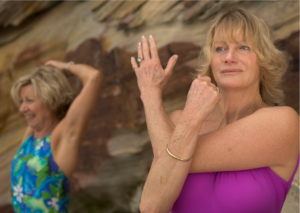 A crucial part of staying healthy as we age is exercise. But with loss of bone mass and lean muscle mass, some people may find high impact exercises too strenuous. Of course, this is all down to the individual.
Swimming does not contribute to the loss of lean muscle mass and does not put any additional strain on bones, as running for long periods might. Joint pain can also be a symptom of perimenopause, and swimming can be good for this as it encourages movement.
It’s still possible to do some light strength training with your swimmers as part of your sessions. This might be a short warm-up run around the venue, or creating resistance within the water, e.g. using flippers or adding in some aqua aerobics.
Whilst you should always be careful about not pushing your swimmers too hard if they’re perimenopausal, the benefits of keeping active far outweigh the risks.
Should someone still exercise if they leak?
Incontinence is very common as humans age and an overactive bladder, or the urge to pee, is common to perimenopause. If one of your swimmers is worried about this, you might suggest they speak to their doctor and look into pelvic floor exercises to help strengthen their pelvic floor.
Your swimmer may regularly go to pilates or yoga which are both great and not to be discouraged as they are both anaerobic exercises — good for increasing estradiol levels in perimenopausal women. However, they do not provide a complete solution for overactive bladder.
Anatomically, two-thirds of your pelvic floor muscles sit behind you, so it’s important to learn how to identify the area and the feeling that can strengthen your pelvic floor muscles. The Menopause Movement course will arm you as a coach with all the knowldege of how to do this properly and how you can incorporate these exercises into your swimming session.
Another great recommendation is the Squeezy app which has been created by physiotherapists and NHS approved. This will help your swimmers practice this skill throughout their day.
Practising these movements can lead to a more bouncy, responsive pelvic floor muscle, which can help reduce incontinence or overactive bladder.
5. The importance of sleep and diet
Along with exercise or movement, sleep and diet are the other two cornerstones of maintaining a healthy body as someone moves into perimenopause.
Sleep
Sleep is important at any age, but particularly during this time.
During perimenopause, your estrogen levels fluctuate. In women, estrogen is the equivalent of an anabolic steroid.
“If we’re losing that, it means that our recovery is slower and rebuilding takes longer. It means that sleep will play a massive part in your recovery.” — Christien Bird.
Sleep gets complicated during menopause. Hot flushes can mean that it’s harder to come by. A lot of women that are going through perimenopause say that they feel more anxious and feeling anxious can lead to poor sleep.
Swimming can help with this because the endorphins released during exercise can help to reduce stress and anxiety. Equally, swimming is a full body workout, so a great way to burn off some excess energy and make your whole body ready for sleep.
You will already understand as a coach that it’s important to be well-rested before a swim. But if your swimmer is feeling well and able, there’s no reason that they shouldn’t swim if they are feeling a little more tired than usual.
Encourage your swimmers to listen to their bodies. If they’re exhausted, then you should be adjusting the goals for that session. A quick dip will also have a great impact on your swimmers mental health and body so maybe reign in the meters and go for a short social swim. Swimming is a great way to help swimmers going through hot flushes, especially in the colder months if they’re perimenopausal and finding sleep patchy thanks to those hot flushes, regular swims in nature can be a wonderful aid to finding natural sleep.
Diet
A common perception of perimenopause is that it contributes to weight gain. This isn’t true. Menopause and perimenopause do not make someone gain weight, but the body composition does change and the metabolism can alter.
Despite this, it is actually more important for those in perimenopause not to have a calorie restrictive diet, particularly if they are exercising.
To add to that, swimming in cold water requires more energy than usual, because it’s a full-body workout and also because your body will consume extra calories keeping warm.
The Menopause Journal tells us, “Menopause has been shown to alter the gut microbiome… associated with increased adiposity, decreased metabolic rate, and insulin resistance.”
So whilst it’s important to eat enough calories, during menopause it’s more important to be careful that they’re the right type of calories. It will be beneficial for your swimmers going through perimenopause to seek expert advice in this field.
6. Community in swimming and menopause
We know that anxiety, and sometimes depression, can be symptoms of perimenopause. A large Australian study on menopausal women in the workplace found many felt stressed and anxious at work, which led to poor self-esteem and loss of confidence.
 In recent years, social prescribing has become more validating and can be a great alternative if HRT isn’t an option or to complement HRT.
Whilst you should always refer your swimmers to their doctor if they broach this subject with you, it’s good to be aware of the benefits of community for those with anxiety or depression, particularly as the outdoor swimming community is both a thriving and an inclusive one.
Remember that only a small part of running an outdoor swimming group is the swim itself. A large part of the session is discussion, risk assessing and debriefing.
Starting with a general discussion around how each person is feeling that day is not only a good way to stay safe in the water but can also flag up if someone is feeling low.
A good way to start any session is with a breathing exercise. This is not only a good way to prepare the body for the water but is also great for anxiety. It can also be a way to break down a few barriers within the group and get everyone feeling on an equal plane.
Likewise, involving all your swimmers in a discussion about entry and exit points, plus any other elements of risk is a good way to help everyone to feel involved.
Consider bringing a few flasks of hot chocolate along to your session. A cup of tea will help your swimmers to warm up after the session but also allows an opportunity for a bit of a debrief and a catch-up.
You will already know how inclusive the open water swimming community is. Christien Bird mentioned during her talk with us how many of the barriers to exercise during perimenopause are about body shame.
People may worry that they’re too fat or not fit enough to exercise, but being in the water is a great leveller in this way as it’s an exercise that can easily be adapted for all fitness levels.
Buddy support is a great way to break the barrier to exercise and as a coach you can aid this by creating a welcoming and familiar environment where your swimmers will want to come back every week, as much for the company as for the swim.
7. Introducing menopause-specific classes to your coaching practice
Menopause is a huge topic with so much research only just coming to light now. At the bottom of this article we will leave a few excellent resources for you to explore.
In the meantime, if you’d like to introduce menopause specific classes to your practice, here are a few steps to take.
- Do your homework — Arm yourself with studies, research and evidence when it comes to menopause. The more of an expert you become on the topic, the easier it will be to tailor a lesson for this group of people.
- Know your limitations — Whilst you may be well read on the topic, it’s important to always refer your swimmer to a medical professional if they come to you for advice.
- Understand the individual — There is no one size fits all approach to menopause. Whilst the advice we’ve given in this article is quite general, you will naturally come across women who already know a lot about nutrition and strength training and some that will know less.
- You don’t have to be a woman to coach women — We encourage all coaches to get involved with this important conversation, regardless of gender or age. Outdoor swimming can be a life-line to many perimenopausal women and by adding menopause specific classes to your practice, you may even enhance the experience for someone.
- Gain the proper knowledge — we have teamed up with the Menopause Movement to offer an amazing discount ontheir courses so you can arm yourself to be as ready as possible to help women through this tough part of their lives. To access this offer head to our partner offer page on the SLS membership site.
Important resources
Menopause Movement: https://www.menopausemovement.co/
Positive Pause: https://www.positivepause.co.uk/
Squeezy: https://www.squeezyapp.com/